SashWeaver
  • Home
  • About the artist
    • Gallery
  • Store
  • Sprang
  • Fingerweaving
  • Virtual Class Room
  • Contact me
  • Blog

Blog

Mindful working

1/1/2026

0 Comments

 
One of the stipulations of the people commissioning the sash was that I needed to sign and date the piece. This needs to be done in an indelible manner. The original sash has a space at the centre of plain stitch. That's where I decided to put the signature and date. I wrote my name CJames, and the date 2026 in S-leaning stitches on the Z-leaning background. You can only see this when the light is right.
Picture
Picture


​I am very happy to report that the work is indeed progressing. Slowly. But progressing. What I've learned .... again ... this past week is that I must PAY ATTENTION. Allowing my focus to drift, an occasional mistake happens: I grab the wrong thread, or only one thread of a pair. If I don't catch this before pushing the row to the mirror image side, the result is a horrible snag and tangle. It disrupts the even-ness of the warp, causes all manner of other problems. I then spend time finding the error and fixing the problems caused. 
A far better approach is to PAY ATTENTION, that is, work with mindful intention, and double check at the end of every row.
​
Once I work a row, then I push that work around to the mirror-image side. This is a circular warp that started out at 14 feet long. Small differences in tension on individual threads, small differences of length, not to mention that it's cold outside, and winter heating means static electricity, and that complicates things as well  ... 
​Pushing the work around to the mirror-image side is a challenge, particularly at the start of the project.
0 Comments

Beginnings are always difficult

12/22/2025

0 Comments

 
Setting up a circular warp for sprang requires care. Setting up a long warp using fine threads demands extra care. Knowing this, I recruited the assistance of helpers. Local weaving enthusiast Paul Sparling volunteered. So did Sarah J Hull, who flew in from DC. She's interested in my work and wanted to participate, get an inside view ... well ... I expect she got an eyeful.
Picture
The experience of the first time through the creation of such a sash told me I'd be wise to have someone watching the cross and counting the threads. The cross absolutely must be 100% correct for the centre of the cloth to be error-free. Paul did this job admirably. Experience has also shown me that tending the umbrella swift, seeing that the threads came off the hank smoothly is another critical job. I've since decided that the stirring of the pot in the dying process tangles the threads slightly. Better to dye the threads first, and then combine into hanks, so that they are less tangled, come off the swift more smoothly. This makes for more consistent tension in the warp.
Picture
The next step is to work the initial row. It's important that each stitch is correct. Any error will show up at the very centre of the work. The challenge is compounded by the fine size of the threads, and even more so that I am working with pairs of threads. Each stitch needs to use the correct two pairs of threads.
Picture
Slight differences in tension mean slight differences in lengths of threads. This causes horrible tangles when pushing to the mirror-image side.
I am stuck in a nightmare. It's like Red Riding Hood facing the wolf. Now, I know how the story goes. I know that the kindly woodsman enters the scene in time. He deals with the wolf, and there is a happy ending. I know from experience that the un-even-ness does work out ... it's just that I'm not there yet. I'm still staring at the open mouth of the wolf.
But the interlinking stitch does have amazing forgiveness. And the silk strands are very strong ... will not break (just trusting that knots in between the various skeins hold tight). The un-even-ness will work out
Picture
0 Comments

The GW Sash project - Dying

12/12/2025

0 Comments

 
The color of the sash that is in the keeping of George Washington's Mount Vernon is red. But what shade of red? I discussed the situation with curator Amanda Isaac.
Dying is not something I consider to be my strong suit. Yes, in the past I've dabbled with plants and flowers, picking the petals, fiddling with mordants. There's just too much to explore there, too many things that affect the color, and I've found it necessary to narrow my focus. I focus on the technique, and short-cut the dye process ... all this to say, I've been using commercial dyes. I've been using Landscapes dyes. They are an eco-friendly dyestuff, using plants rather than chemicals.

To determine the "right" shade of red, I wound up six small skeins. I placed them in pairs and dyed them, each pair in a different teacup, each a different shade of red.

One set I sent off to the curator, the other set I kept for my records.


Picture
She chose "chili" .... so that's the color I'll use.
Picture
I had the silk in skeins, each skein containing two parallel strands, as that's what is in the original sash.
Each skein is tied in several places. I am hoping to avoid the threads getting tangled within the skein, and will not be a problem when I get to warping.

I soaked the skeins ahead of time, prepared my depot and lowered the skeins into the dyepot.
Here is the silk in the dye pot. I followed the recipe for the Landscapes dyestuff.
Picture
Picture
Here are my freshly dyed skeins, ready for warping.
That step is planned for Monday, December 15.
In the mean time, waiting for Warping Day, I've set up a "narrow" warp (200 pairs of threads) to work a sample piece. I need to "train" my fingers and my eyes to this fine silk.

I was glad I did. I remembered a couple of challenges that I faced last time. I discovered again how important it is, when using pairs of fine threads, to push each row around before starting the next row. It's waaaay too easy to grab an incorrect pair of threads, and then it is impossible to push that bit around to the other side.
No shortcuts, Carol. No working several rows before pushing around. Remember that, Carol!

Picture
0 Comments

The Washington-Braddock sash again

11/16/2025

0 Comments

 
It all started back in 2009. I was looking at a photo of a sash with a date of 1709, and the hairs on the back of my neck stood up. I thought, "That's exactly 300 years ago".

Encouraged by the success of my book Fingerweaving Untangled. I was contemplating writing another book. What would be the subject? What textile method was I sufficiently familiar with, that needed an instruction book? The answer was sprang.
Something people said they really liked about Fingerweaving Untangled was that it included pieces from museums. What pieces could I include in my book on sprang? Perhaps I could write to museums and get permission to use photos of bonnets from Scandinavian peat bogs or ancient Egypt. But, I thought, my audience would be mostly North America. Are there any examples of North American sprang? 
Looking through Peter Collingwood's book Techniques of Sprang I found an excellent example in the photos at the back. There is a photo that says it's George Washington's sash. I thought to myself, "That's the piece to entice North Americans". So I wrote to George Washington's Mount Vernon. Certainly they were the ones holding that sash.
The photo they sent to me was of a different sash (apparently George Washington owned more than one sprang sash). The sash in the collection at George Washington's Mount Vernon is the one given to him while serving in the British Army in 1855. His commanding officer, Edward Braddock, mortally wounded, passed the sash to Washington, effectively handing over command of the troops.
​The photo they sent featured interesting lace patterns, probably do-able, I figured, with sprang, but the photo did not show the mirror-image aspect that always happens with sprang. Thus began some back-and-forth correspondence asking them to verify that it is indeed a sprang sash. 
Something compelled me forward in this project. Something about the date of 1709, being exactly 300 years ahead of that day in 2009 when I first saw that photo.In the end, I offered to come visit to answer my own questions. If they'd give me ample time to examine it, I promised that I'd make them a replica.
This was not a totally rash offer. I'd worked through several sections of Peter Collingwood's book. I'd re-created several lace patterns featured in his book. The challenge would be to work with such fine material and create something larger than I'd previously attempted.
Picture
Carol and the Braddock-Washington sash at George Washington's Mount Vernon
I had met up with the sprang technique in the 1990s. Fascinated, I needed to learn more. Local yarn stores taught classes in knitting and crochet. The local hand weavers guild offered instruction in loom weaving. No where could I find a class on the subject of sprang. I decided that I would need to create the opportunity to travel and that my teachers would be examples of sprang in collections.
The Braddock-Washington sash was one such teacher, and I learned a great deal from that sash.
I did succeed in making a copy of that sash, and delivered it to George Washinton's Mount Vernon in the spring of 2013.

​At that time they had just completed a new visitor's centre, complete with an area to display garments worn by George and Martha Washington. The trouble was that the space had been already completely planned and there was no place for my sash to be displayed. A number of people have told me that they nevertheless have succeeded in seeing my replica, with special arrangements made ahead of time.


Picture
Carol and her replica sash
The people at George Washington's Mount Vernon tell me that the replica sash has created much interest. One aspect was the test of the story that the mortally wounded General Braddock was carried off the field on the sash. People have asked whether or not this could have really happened. My replica has allowed this theory to be tested ... and yes, the silk fibers are strong enough.
Picture
All this comes up for me because of a series of events last Summer. The eventual outcome is that I am now committed to making another copy of that sash for George Washington's Mount Vernon. ​​​​​They will be unveiling a new display on July 4, 2026. That display will include my replica sash, and, having a replica on display, it's their policy that they need a second replica. Hence this, my latest project.

Figuring people like you, out there in the world of the internet, might be interested in the process of making such a sash, I am hereby committing myself to try to remember to blog about the process. 
Yeah, if you look, you'll see I've not been very faithful to this blog over recent years. But I promise to give it a try, to try to remember to update this blog over the course of the next few months, keeping you informed of the progress of this project: replicating (again) the Washington-Braddock sash.
0 Comments

Carlyle House Display

6/22/2018

2 Comments

 
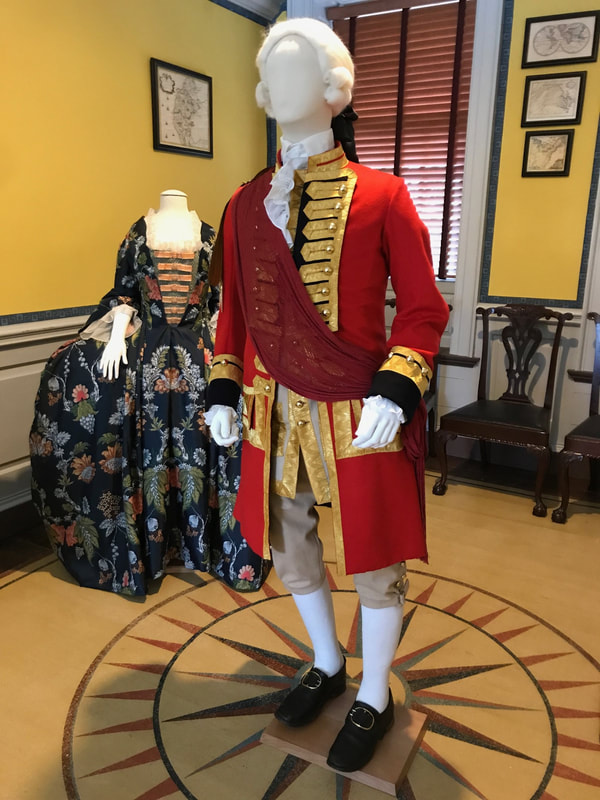
Last Summer I made a scaled down copy of the Braddock-Washington sash for Carlyle House. The word is that the display is now complete, and viewable to the public. Here is the photo they sent me, the mannequin wearing the general's uniform .... complete with sash.
Picture
2 Comments

Rupertsland

5/21/2012

0 Comments

 
Attended the University of Winnipeg’s Centre for Rupertsland Studies, presenting a paper on sprang. Met some amazing researchers, learned lots more about the Fur Trade.
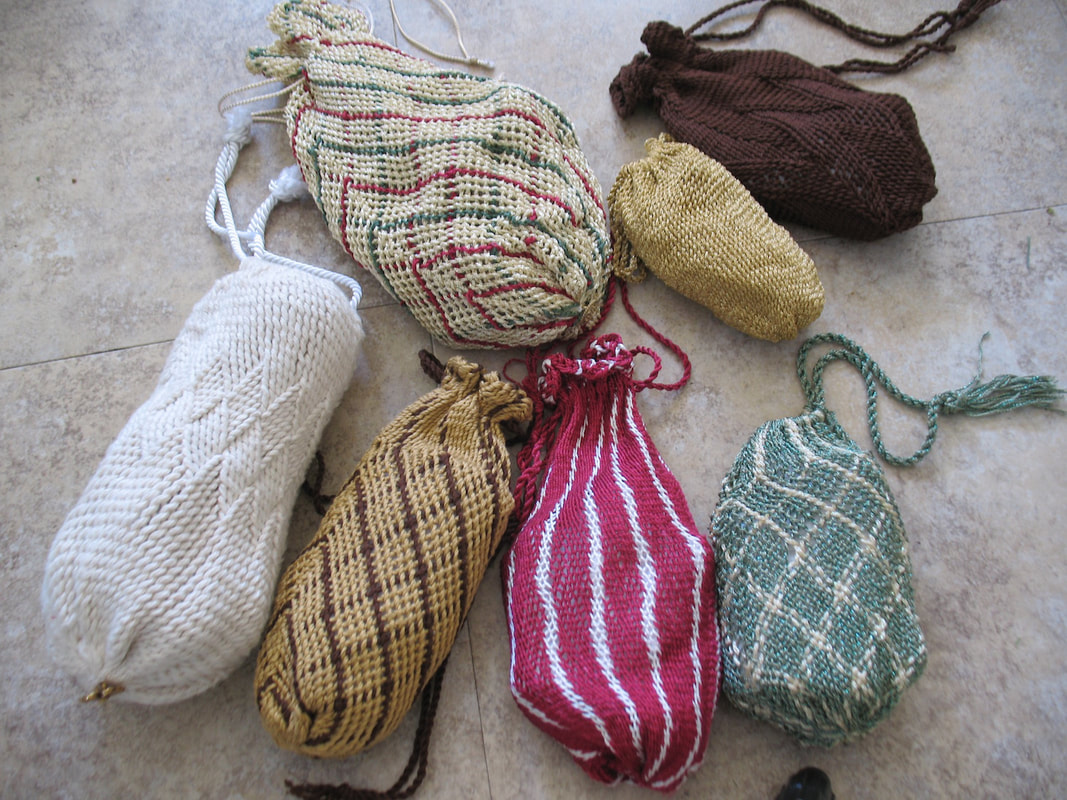
All that sitting and demonstrating, I made several sprang purses.
Picture
Sprang bags, interlinking and intertwining
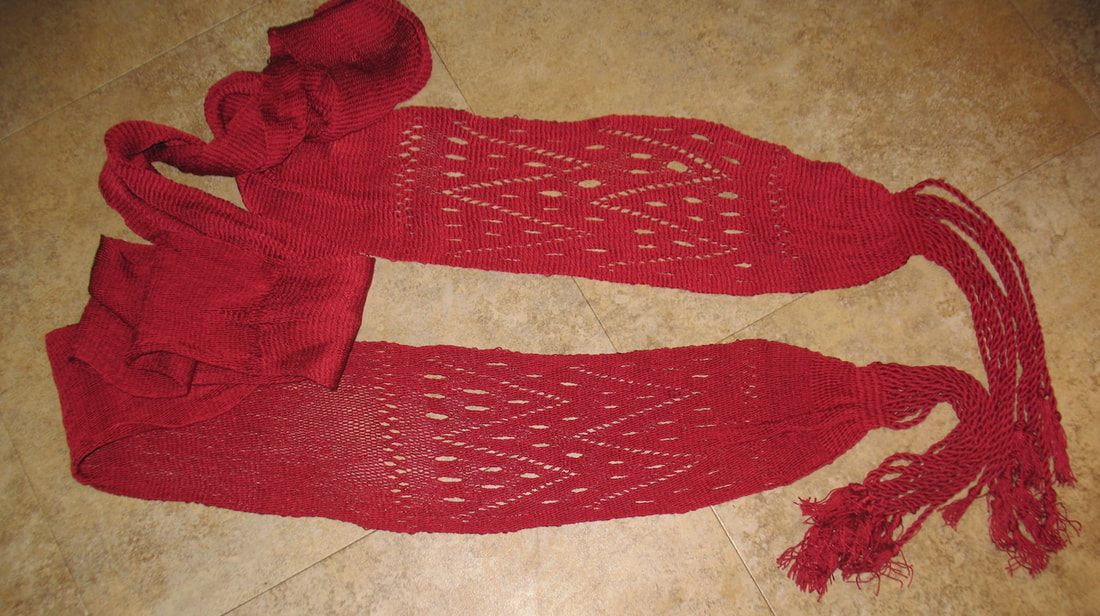
I’ve also been working on another silk military sash.
Starting with a 13 ft warp, I now have an 11 ft sash. Two feet of ‘shrink’ on this one.
Picture
Silk military sash with patterning
0 Comments

January Experiments

1/7/2012

0 Comments

 
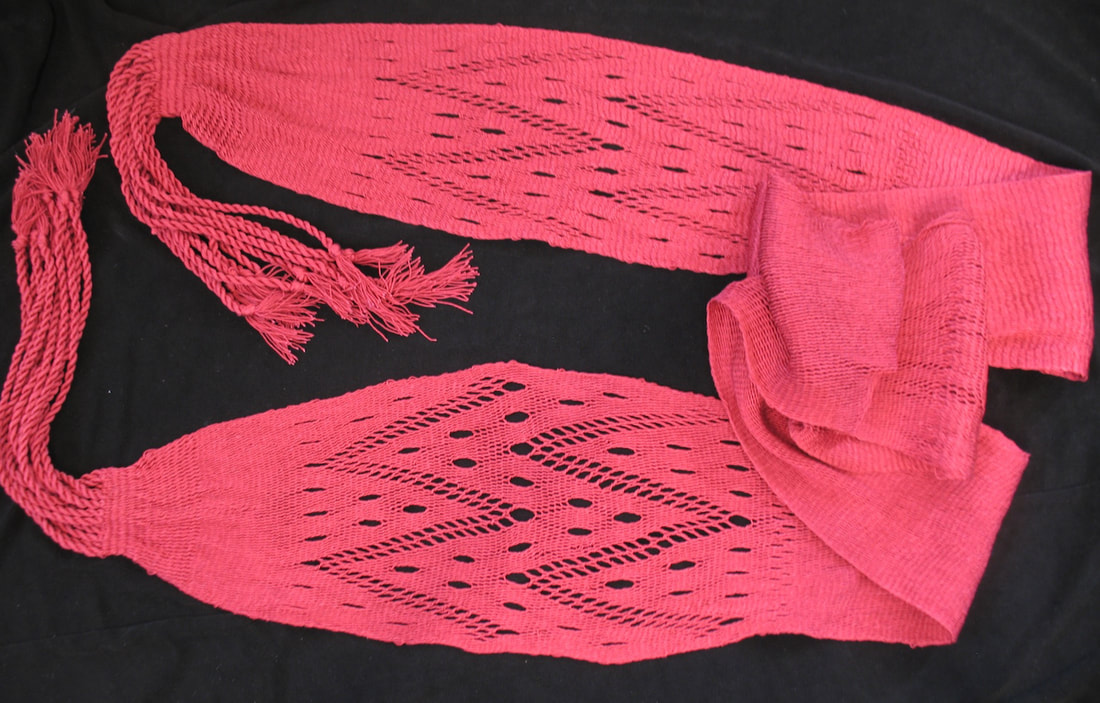
I recently finished up another of those silk officer sashes.
Picture
Silk Sash Finished
I’ve been experimenting with different types of silk. Reeled silk is best because the fibers are nice and long. I’ve found that silk cording gives a better look, and probably better wear. Original silk sashes that I have examined seem to be composed of several very fine strands all worked as one. I tried doing just that and found the ‘hand’ of the results to be quite lovely. Working with multiple strands, keeping them all in their proper bunches was a bit of a headache, made the weaving go lots slower.

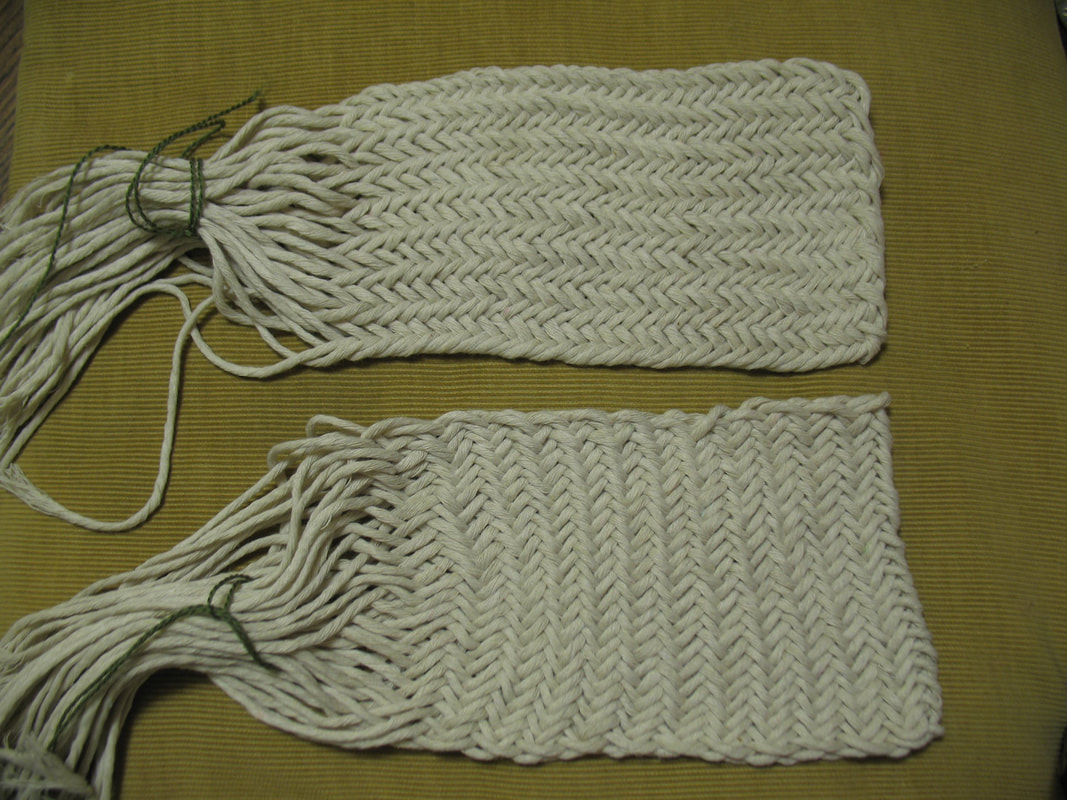
In other news, a researcher dealing with a mummie and associated textiles has got me playing with that 3-3 interlacing. The mummie cloth had the arrows in the cloth going sideways to the way I usually do the 3-3 interlacing. So I set me up a warp and had a good look at my 3-3 interlacing, and worked the new warp sideways. Now something niggled in my brain, and I went back to Collingwood. Sure enough Collingwood describes ‘horizontal ribs’ as well as ‘vertical ribs’. Here are my trial pieces, done in free-end braiding:

Picture
-3 Interlacing, horizontal and vertical ribs
0 Comments
    Carol's blog archive

    RSS Feed

    Categories

    All
    Arizona Openwork Shirt
    Art
    Book Reviews
    Books
    Braddock Sash
    Ceinture Fleche
    Clothing
    Demonstration
    Dying
    Easily Transported Work
    Exhibit
    Exploration
    Fashion Show
    Fashion Sow
    Finger Weaving
    Inspiration
    Instruction
    Loom Weaving
    Media
    Military Sash
    Museum Replica
    Museum Visit
    No Frame Sprang
    No-frame Sprang
    Patterns
    Privite Commissinons
    Publications
    Research
    S And Z
    Sash Dance
    Sprang
    Sprang Bonnets
    Sprang Bonnets Of The 1500s
    Sprang Bonnets Of The 16th Century
    Sprang Bonnets Of The Renaissance
    Sprang Clothing
    Sprang Frame
    Sprang History
    Sprang Lace
    Sprang Leggings
    Sprang Patterns
    Sprang Twining
    Student Pieces
    Tablet Weaving
    Tips And Tricks
    Travel
    Weaving
    Website
    Workshops

    Archives

    April 2026
    March 2026
    February 2026
    January 2026
    December 2025
    November 2025
    July 2025
    May 2023
    March 2023
    February 2023
    August 2022
    June 2022
    July 2021
    June 2021
    April 2021
    February 2021
    January 2021
    December 2020
    August 2020
    May 2020
    April 2020
    March 2020
    February 2020
    January 2020
    December 2019
    October 2019
    August 2019
    June 2019
    May 2019
    April 2019
    March 2019
    February 2019
    January 2019
    November 2018
    October 2018
    August 2018
    July 2018
    June 2018
    May 2018
    March 2018
    February 2018
    December 2017
    November 2017
    October 2017
    September 2017
    August 2017
    June 2017
    May 2017
    April 2017
    March 2017
    February 2017
    November 2016
    August 2016
    March 2016
    February 2016
    November 2015
    October 2015
    August 2015
    June 2015
    April 2015
    March 2015
    December 2014
    November 2014
    September 2014
    August 2014
    July 2014
    May 2014
    April 2014
    March 2014
    February 2014
    December 2013
    November 2013
    October 2013
    September 2013
    August 2013
    March 2013
    February 2013
    December 2012
    November 2012
    October 2012
    September 2012
    August 2012
    July 2012
    June 2012
    May 2012
    April 2012
    March 2012
    February 2012
    January 2012
    December 2011
    November 2011
    October 2011
    September 2011
    August 2011
    July 2011
    June 2011
    May 2011
    February 2011
    November 2010
    October 2010
    August 2010
    July 2010
    June 2010
    May 2010
    April 2010
    March 2010
    February 2010
    August 2009
    July 2009
    May 2009
    April 2009
    February 2009
    January 2009
    December 2008
    November 2008
    October 2008
    September 2008
    August 2008
    July 2008
    June 2008
    May 2008
    March 2008

    Categories

    All
    Arizona Openwork Shirt
    Art
    Book Reviews
    Books
    Braddock Sash
    Ceinture Fleche
    Clothing
    Demonstration
    Dying
    Easily Transported Work
    Exhibit
    Exploration
    Fashion Show
    Fashion Sow
    Finger Weaving
    Inspiration
    Instruction
    Loom Weaving
    Media
    Military Sash
    Museum Replica
    Museum Visit
    No Frame Sprang
    No-frame Sprang
    Patterns
    Privite Commissinons
    Publications
    Research
    S And Z
    Sash Dance
    Sprang
    Sprang Bonnets
    Sprang Bonnets Of The 1500s
    Sprang Bonnets Of The 16th Century
    Sprang Bonnets Of The Renaissance
    Sprang Clothing
    Sprang Frame
    Sprang History
    Sprang Lace
    Sprang Leggings
    Sprang Patterns
    Sprang Twining
    Student Pieces
    Tablet Weaving
    Tips And Tricks
    Travel
    Weaving
    Website
    Workshops

Contact Carol

Store

FAQ

Privacy policy
Carol acknowledges that we are on Treaty 1 territory, the traditional gathering place of the Anishinaabe, Cree, Oji-Cree, Dakota and Dene people and the traditional homeland of the Métis people. Carol also acknowledges that sprang is part of many  indigenous traditions  and found in various forms all over the world. Let us re-discover this technique together.
© COPYRIGHT 2022. ALL RIGHTS RESERVED.
  • Home
  • About the artist
    • Gallery
  • Store
  • Sprang
  • Fingerweaving
  • Virtual Class Room
  • Contact me
  • Blog